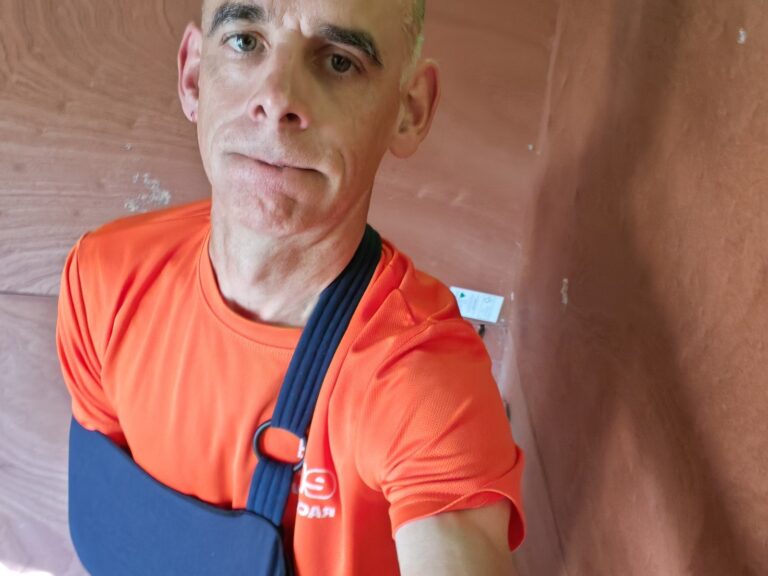
Earlier this year I spent several weeks with my left arm strapped across my chest, recovering from surgery to reconstruct my AC joint. If you have ever been there, with a broken collarbone or a wrecked shoulder or an arm you are simply not allowed to use, you know the particular gloom of watching hard-won strength drain out of it while you wait. It turns out you are not as helpless as the sling makes you feel. The trick is to train the arm that still works.
The Research
Researchers pooled eight studies covering 189 healthy adults who wore a sling or cast on one arm for three to four weeks. In each, participants kept resistance-training the free limb while the other stayed immobilised. The result was consistent: training the good limb measurably slowed strength loss in the idle one (a moderate effect, Hedges’ g = 0.53) and preserved a little muscle size as well (g = 0.19). This is “cross-education”, a long-known quirk of the nervous system in which strength gains cross over to the untrained side. What is new here is a proper number attached to it, and the finding that the trained and immobilised limbs respond in lockstep. In plain terms, the harder you train the working side, the more protection the injured side seems to get.
What This Means for Cyclists
Road cyclists lose upper-body immobilisation battles more often than most athletes. Clavicle fractures and AC joint injuries are among the most common results of coming off the bike, and both usually mean a spell in a sling. This research says that spell does not have to be dead time for the injured arm, a point I wish I had taken more seriously in my own.
If your left shoulder is immobilised, load the right shoulder and arm deliberately, working the same muscle groups you cannot train on the injured side. Intensity is what carries the effect, so near-maximal eccentric work or full lifting through both the lowering and lifting phases beats light, easy isometrics. Three sessions a week is the pattern the studies used. Expect this to protect strength well and muscle size only modestly, so treat it as damage limitation rather than a full substitute for training both sides.
Two honest limits are worth stating to anyone you coach. Every study in this review used healthy volunteers wearing a sling by choice, not people dealing with real post-surgical pain, swelling and a healing repair, so start gently and stay inside what your surgeon allows. The second point is more encouraging than it first looks. This particular review only examined arms, but cross-education is actually better documented in the legs, where the transfer tends to be larger, so the principle almost certainly holds for a rider immobilised after knee or ankle surgery. The narrower honest gap is that the few trials testing it during real leg immobilisation, mostly after ACL reconstruction, disagree on whether it speeds functional recovery. So treat leg training as sound in principle and worth doing, but do not promise it will get you back on the bike sooner.
The Bottom Line
A sling on one arm does not have to mean surrender on that side. I know how passive those weeks feel, and the evidence says they need not be. Training the healthy limb hard, three times a week, with real intensity, slows the strength loss on the injured side while you heal. It is simple, free and backed by pooled evidence, though the studies were small and none was free of bias, so hold the finding firmly rather than tightly. If you have ridden through a shoulder injury, I would genuinely like to know: would you have tried this?
Reference
Rodríguez-Coloma, M., Scott, L. D., Bascour-Sandoval, C., Castillo-Vejar, L., Carr, J. C., & Andrushko, J. W. (2026). Cross-education of unilateral resistance training as a strategy to mitigate immobilization-induced neuromuscular decline: a systematic review and meta-analysis. Journal of Applied Physiology. https://doi.org/10.1152/japplphysiol.00081.2026
Evidence quality: Meta-analysis/Review (medium confidence). Synthesised via the Cycling Science Living Knowledge Base.
Apply this to your training
Want to train with the science behind you? Prof. Richard Davison offers evidence-based coaching built on exactly this kind of research.
View coaching packages →