
Menstrual-cycle-phase training plans have become a popular idea in endurance sport, promising better sessions if hard efforts are timed to the right week. A new qualitative study of competitive female cyclists suggests the real problem sits a step earlier than phase timing: almost nobody involved, riders or the people coaching them, had a clear, evidence-based picture of what was actually happening.
The Research
Researchers interviewed 20 UK competitive female cyclists, from club level through international elite, about their lived experience of the menstrual cycle and its effect on training. Eighty percent believed their cycle or hormonal contraception affected performance, most often around and during the first days of their period, and near-universal symptoms such as cramps, bloating and fatigue were common across the group. It was the severity of an individual’s symptoms, not which phase of the cycle she was in, that best tracked how she described feeling impaired. Yet despite four in five holding that belief, not one of the 20 riders was systematically recording her symptoms against actual cycle days. The link most of them were confident about was being managed on memory and impression, not on any record. Nearly half also reported current or past menstrual irregularity, often waved off by riders and by coaches or medical staff alike as a normal sign of hard training rather than a possible warning of under-fuelling.
What This Means for Cyclists
The single most useful, and cheapest, change here is also the most obvious one that nobody in this study had made: start logging energy, mood, gut symptoms, pain and session quality against the actual day of the cycle, for at least a few months, rather than relying on how last month felt in hindsight. Guidance in this space suggests roughly three full cycles of data before a real pattern can be told apart from ordinary noise, which is exactly the kind of tracking this group of competitive athletes had not been doing.
There is a safety point underneath this too. A missing or irregular period is not a normal cost of training hard, it is a signal worth taking seriously and screening for, not something to normalise as dedication.
The study also points to simple, practical fixes that have nothing to do with physiology. Saddle and labial sensitivity during menses, and the logistics of managing periods and products on long rides, were pushing some riders toward shorter or indoor sessions rather than the outdoor riding they wanted to do. And while most riders had told their coach something, it was often reduced to a note in a training app rather than an open conversation, in a sport still coached mostly by men, several of whom the riders described as similarly under-informed. Building a genuinely comfortable channel to talk about this, alongside the physiological picture and the tracking, is itself a performance intervention.
The Bottom Line
Four out of five riders in this study believed their cycle was shaping their performance, and not one of them was recording anything to actually check it. Fix that gap before reaching for a phase-based training template: track symptoms against real cycle days for a few months, treat irregularity as a health flag rather than a training badge, and build an open channel with coaches who need to be equipped for this conversation as much as riders do.
If you’re a female rider or coach, has anyone in your training environment actually tracked this over time, or is it still managed on memory and gut feeling?
Reference
Burnie L, Ansdell P, Allen-Baker G, Pastorio E, Hicks KM, Heron N, Brown N (2026). Female cyclists’ perceived effects and experiences of the menstrual cycle on training and performance. PLOS One. https://doi.org/10.1371/journal.pone.0343892
Evidence quality: Single study. Synthesised via the Cycling Science Living Knowledge Base.
This post is grounded in peer-reviewed research. Female cyclists’ perceived effects and experiences of the menstrual cycle on training and performance (Burnie et al., 2026) was synthesised into the Cycling Science Knowledge Base on 5 July 2026.
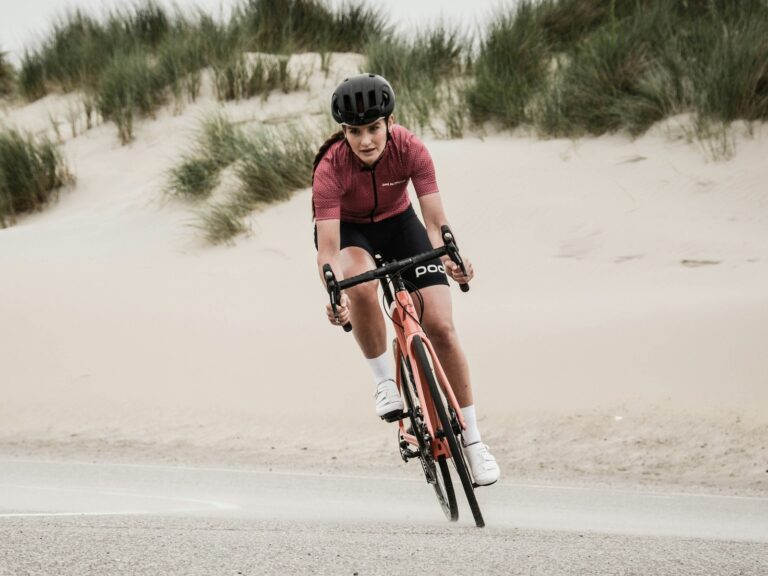
Hero photograph by Coen van de Broek via Unsplash.
Apply this to your training
Want to train with the science behind you? Prof. Richard Davison offers evidence-based coaching built on exactly this kind of research.
View coaching packages →