
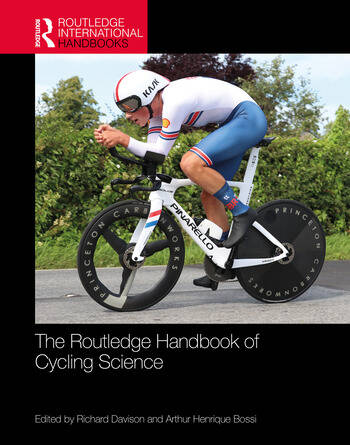
The Routledge Handbook of Cycling Science
Edited by Richard Davison and Arthur Henrique Bossi
Routledge · Routledge International Handbooks · 1st Edition
The most comprehensive reference work in cycling science to date. 43 chapters from internationally recognised researchers, bringing together the experimental and applied evidence and showing how to use it to improve performance at every level.
Pre-ordering opens 27 October 2026. Routledge will take your details now and tell you when it does.
What is inside
43 chapters spanning the full breadth of the field, written by leading sport scientists and coaching academics and supported by the most recent peer-reviewed evidence.
Race demands
What competition actually asks of the rider, discipline by discipline, from the power profile of a track sprint to the pacing of an ultra.
Physiology
The physiological determinants of cycling performance, and what current evidence says about testing, profiling, and monitoring them.
Training methods
Intensity distribution, periodisation, overload and recovery, and the methods that hold up when the evidence is examined closely.
Nutrition
Fuelling for training and racing, body composition, and energy availability, including relative energy deficiency in sport.
Equipment and technology
Aerodynamics, position, power measurement, and the equipment decisions that change performance in measurable ways.
Tactics and analysis
Race tactics, performance analysis, and the growing role of data and artificial intelligence in coaching practice.
Environmental factors
Heat, cold, altitude, and the other conditions that shape what a rider can produce on the day.
Health
The health of the cyclist alongside the performance of the cyclist, across the training lifespan.
Every rider, not only the professionals
Cycling science is too often written as though the only athlete who matters is a male elite road professional. The Handbook covers the full spectrum of cyclists.
- Elite road and track riders
- Masters athletes
- Youth riders
- Female cyclists
- Paracyclists
Across the disciplines
From a forty-second track sprint to a multi-day gravel event, the physiological and tactical demands differ enormously. Each is treated on its own terms.
- Sprint track
- BMX
- Endurance road racing
- Mountain biking
- Ultra-endurance
- Gravel
It says where the evidence runs out
Reference works have a habit of presenting a settled consensus that does not exist. The Handbook does the opposite. Contested topics such as training intensity distribution, relative energy deficiency in sport, and the use of artificial intelligence in coaching are examined critically, with contributors saying plainly where the evidence is equivocal and where consensus has not been reached.
Every chapter closes with a dedicated future research section, making the gaps in current knowledge explicit and setting an agenda for the field. It is the same principle the Cycling Science knowledge base is built on: you should always know how strong the evidence behind a recommendation actually is.
See how the knowledge base grades evidenceTable of contents
All 43 chapters across 9 sections, with their contributing authors.
Introduction
- 1
Introduction
Richard Davison and Arthur Henrique Bossi
Section I · Demands of Competitive Cycling
- 2
Demands of Competitive Cycling: Short-Distance Events
Hamish A. Ferguson and Christopher R. Harnish
- 3
Biomechanics of Sprint Cycling
Louise Burnie, Paul Barratt, and Jon Wheat
- 4
Demands of Endurance Cycling Races
Guilherme Matta and Arthur Henrique Bossi
- 5
Ultra-Endurance Cycling
Guilherme Matta and Nicolas Berger
- 6
The Demands of Multi-Stage Cycling Races
Peter Leo and Iñigo Mujika
- 7
Off-Road Races
Matthew C. Miller, Philip W. Fink, and Carl D. Paton
Section II · Physiological and Performance Assessment for Cyclists
- 8
Critical Power: Theory, Methods, and Application
Mark Burnley, Jamie S.M. Pringle, and Andrew M. Jones
- 9
Body Composition in Cycling Performance
Richard Davison
- 10
Explosive Power
Joe Hewitt and Len Parker Simpson
- 11
Incremental Testing in Cycling
Richard Davison
- 12
Neuromuscular Fatigability and Fatigue Resistance during Cycling
Callum G Brownstein, Danilo Iannetta, and Paul Ansdell
- 13
Utilising Training Data to Monitor Physical Progression and Fatigue
Dajo Sanders, Teun van Erp, and Kurt Bergin-Taylor
Section III · Training for Cycling Performance
- 14
Individual Differences in Cycling: Genetics, Training Response, Nutrition, and Pacing
Arthur Henrique Bossi and Richard Davison
- 15
Training Zones
Arthur Henrique Bossi and Felipe Mattioni Maturana
- 16
Power-Based Measurement and Training in Cycling
Richard Davison and Uli Schoberer
- 17
Heart Rate-Based Training
Alejandro Javaloyes, Manuel Mateo-March, Iván Peña-González, and Manuel Moya-Ramón
- 18
Training Load Monitoring in Cycling
Shaun McLaren, Jeffrey A. Rothschild, and Dajo Sanders
- 19
Improvement of Cycling Performance by Means of Strength Training
Ernst Albin Hansen and Mathias Vedsø Kristiansen
- 20
Training Intensity Distribution (TID) in Cyclists: A Review of Evidence and Methodological Challenges
Shawn Bearden
- 21
Tapering and Peaking for Road Cycling Events
Peter Leo and Iñigo Mujika
Section IV · Bike Setup for Comfort and Performance
- 22
Aerodynamics and Bike Fit
Bert Blocken, Fabio Malizia, and Steve Faulkner
- 23
Physiological and Biomechanical Basis for Positional Optimisation
Steve Faulkner, Jonathan Wheat, and Daniel Williams
Section V · Nutritional Strategies for Cycling Performance
- 24
Carbohydrates—Storage, Utilization, and Implications for Performance in Cycling
Niels Ørtenblad, Kasper Gejl, and Lars Nybo
- 25
Hydration in Cycling
Adam D. Seal and Stavros A. Kavouras
- 26
Dietary Strategies to Effectively Reduce Body Mass
J. Marc Fell, James E.P. Moran, and James P. Morton
- 27
Supplements to Improve Cycling Performance
Bryan Saunders, Liliana Kataryne Ferreira Souza, Ricardo Augusto Silva de Souza, and Alfonso Meira
Section VI · Cycling Racing Strategies
- 28
Climbing
Simon Jobson
- 29
Pacing Strategy in Cycling
F.J. Hettinga and S.G.P. Menting
- 30
Group Riding Dynamics
Bert Blocken and Ian M Griffiths
- 31
Performance Analysis in Cycling
Teun van Erp, Dajo Sanders, and Kurt Bergin-Taylor
Section VII · Specialist Cycling Applications and Unique Groups
- 32
Handcycling
Jonpaul Nevin and Paul M. Smith
- 33
The Master Cyclist
Richard Davison
- 34
The Female Cyclist
Lesley Ingram-Sills
- 35
Paracycling
Gary Brickley
- 36
The Youth Cyclist
Alfred Nimmerichter, Michael Methlagl, and Bernhard Prinz
Section VIII · Environmental Factors Affecting Cycling Performance
- 37
Altitude
Giovanni Vinetti
- 38
Cycling in the Heat: Challenges and Opportunities
Lars Nybo
- 39
Cold
José-Antonio Salas-Montoro and Mikel Zabala
- 40
Vibration Measurement in Cycling: Methods and Applications
Mark D. Taylor and Louis Moore
Section IX · The Role of Sport Science in Coaching Cyclists
- 41
Integrating Sports Science into Effective Coaching Practices
Andy Kirkland
- 42
Integration of Artificial Intelligence in Coaching
Nicolas Berger, Paul B. Laursen, and Andrea Zignoli
- 43
Cycling Injuries and Illness
Thomas Fallon and Neil Heron
Contents as listed by the publisher and subject to change before publication.
Who it is for
Sport scientists
A current, referenced synthesis of the field in one place, with the open questions made explicit rather than glossed over.
Coaches
Chapters written to translate the evidence into practice, including where the evidence does not yet support a confident recommendation.
Students
A reference work that maps the whole of cycling science, suitable for undergraduate and postgraduate study in sport and exercise science.
Athletes
For riders who want to understand the reasoning behind their training rather than take it on trust.
The editors
Prof. Richard Davison
Exercise physiologist with more than 35 years in academia and coaching, currently Visiting Professor of Exercise Physiology at the Mountain Bike Centre of Scotland, Edinburgh Napier University. A Fellow and former President of the European College of Sport Science Congress, and a Fellow, former Chair and Honorary Treasurer of the British Association of Sport and Exercise Sciences. He has held editorial board positions at the Journal of Sports Sciences, the Journal of Sport Medicine and the Journal of Science and Cycling, and has contributed to the BASES Physiological Testing Guidelines since 1996. Twenty-two years a coach educator with British Cycling, his research and expertise have supported riders to British and World Championship victories and to the Commonwealth and Olympic Games. He hosts the Cycling Science Podcast.
Read the full biography →Dr Arthur Henrique Bossi
Lecturer and applied researcher at Edinburgh Napier University, working in exercise physiology and endurance performance. His research asks why riders respond differently to the same training, and how to turn that into individualised interventions. He came to the lectureship after more than 12 years coaching cyclists at every level, from beginners to elite mountain bikers, and consulting for the Mountain Bike Centre of Scotland.
Coming 17 November 2026
Pre-ordering opens 27 October 2026. Routledge will take your details now and tell you when it does.
Hardback · 550 pages · ISBN 9781032649092 · Routledge, 17 November 2026