
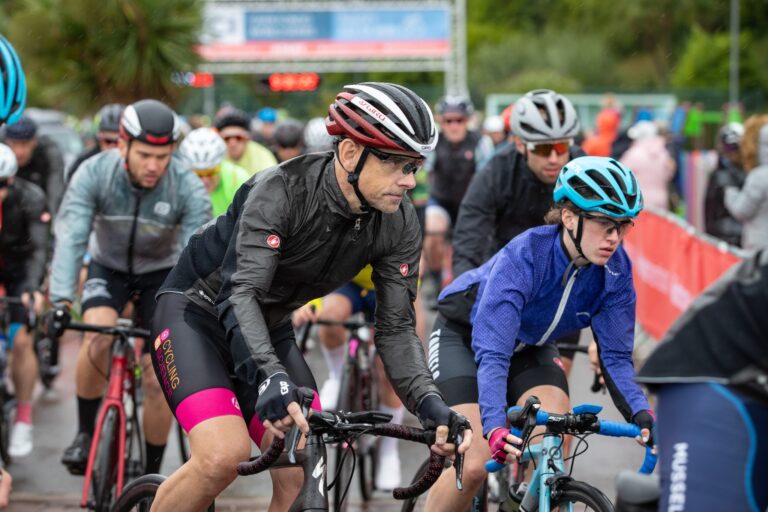
Every sportive starts the same way. The road tilts up for the first time, a group comes past, and you decide in about three seconds whether to go with them. Data from nearly 6,600 finishers of one of Europe’s hardest Gran Fondos suggests that letting them go is the right move.
The Research
Researchers analysed chip-timing data from the 2025 Quebrantahuesos, 197.2 km with 3,190 m of climbing, taking seven timed splits from 6,589 finishers. Each split was expressed as a percentage of that rider’s own average speed, so the measure describes how evenly someone covered the course rather than how fast. Riders finishing under six hours had a spread between their quickest and slowest split of 116.7 percent, while every slower finishing band sat between 124 and 131 percent. The fastest riders also opened more conservatively on the first climb, spent proportionally less of their total time on the two steepest mid-race ascents, and pulled away most in the closing split. A clustering analysis then found three distinct pacing shapes that did not simply track finishing time.
What This Means for Cyclists
The practical version is simple. On a long mountainous day, pace the opening climb by your own effort, using power or perceived exertion, and not by the wheels going past. The riders who finished fastest here started at a lower fraction of their own average speed and still had something left in the closing hour. Going with the early group costs more than it looks, because the time it buys on the first climb is repaid with interest over the last 40 km.
The nuance matters too. Do not treat a flat speed profile as the goal in itself. The cluster with the very flattest profiles, at 112.5 percent, was also the slowest, finishing on average at 8 hours 54, while the fastest cluster at 7 hours 02 sat mid-range at 126.8 percent. On a course with 3,000 m of climbing an even speed is physically impossible anyway. Low variability is a signature of good pacing, not a cause of it.
Coaches should also know how thin the statistical margin is. The overall group effect on pacing variability explained under two percent of the variance, and only the sub-six-hour band separated cleanly from the rest. Because relative speed is normalised to each rider’s own average, the profile shape partly describes how much better someone climbs than they ride the flat, where drafting compresses everyone together. That leaves an open question the data cannot settle: are the fast riders pacing better, or simply expressing more of their fitness where the road goes up? Durability is a third possibility, and a strong one. The faster riders may simply have held their power better into the fifth and sixth hour, which is exactly the quality that fatigue-resistance research keeps finding separates competitive levels.
The Bottom Line
Pacing does matter, so start the first climb slower than feels right. Aim to be riding strongly in the final hour rather than defending a gap you took early. Do not chase an even speed on a hilly course, because that is the wrong target. That pacing strategy changes finishing time is long established, from the modelling and track work of the 1990s through to field trials on hilly courses. What this particular study cannot tell you is whether the opening-climb pattern it describes is a cause of finishing well or a consequence of being fit enough to finish well.
Reference
Sánchez-Jiménez JL, Priego-Quesada JI, Oficial-Casado F (2026). Pacing strategies in Gran Fondo cycling: a large-scale analysis of the Quebrantahuesos race. Sport Sciences for Health. https://doi.org/10.1007/s11332-026-01828-0
Evidence quality: Single study. Synthesised via the Cycling Science Living Knowledge Base.
This post is grounded in peer-reviewed research. Pacing strategies in Gran Fondo cycling: a large-scale analysis of the Quebrantahuesos race (Sánchez-Jiménez JL, Priego-Quesada JI, Oficial-Casado F, 2026) was synthesised into the Cycling Science Knowledge Base on 21 July 2026.
How do you pace the first climb of a big sportive: by the numbers, by feel, or by whoever rides past?
Apply this to your training
Want to train with the science behind you? Prof. Richard Davison offers evidence-based coaching built on exactly this kind of research.
View coaching packages →