
Power meters, glucose monitors, sweat patches, core-temperature wearables: the modern cyclist is drowning in gadgets that promise to sharpen fuelling and training. A UCI-commissioned expert panel has now graded the most common ones, and the honest answer is that only a handful clear the bar. The rest either measure the wrong thing or measure it too crudely to change a decision.
The Research
Writing in the International Journal of Sport Nutrition and Exercise Metabolism, Gonzalez and colleagues critically appraised the technologies used to guide cycling nutrition: power meters, continuous glucose monitors (CGM), portable sweat and lactate analysers, non-invasive muscle-fibre typing, ultrasound for muscle glycogen and body fat, wearable core-temperature sensors, and portable metabolism analysers. For each, they asked two blunt questions. Is the device valid and reliable, and is there any real rationale for using its data to change what an athlete eats or does? Because this is a consensus review of the wider evidence base, its verdicts carry real weight, though each inherits the strength of the primary studies behind it.
What This Means for Cyclists
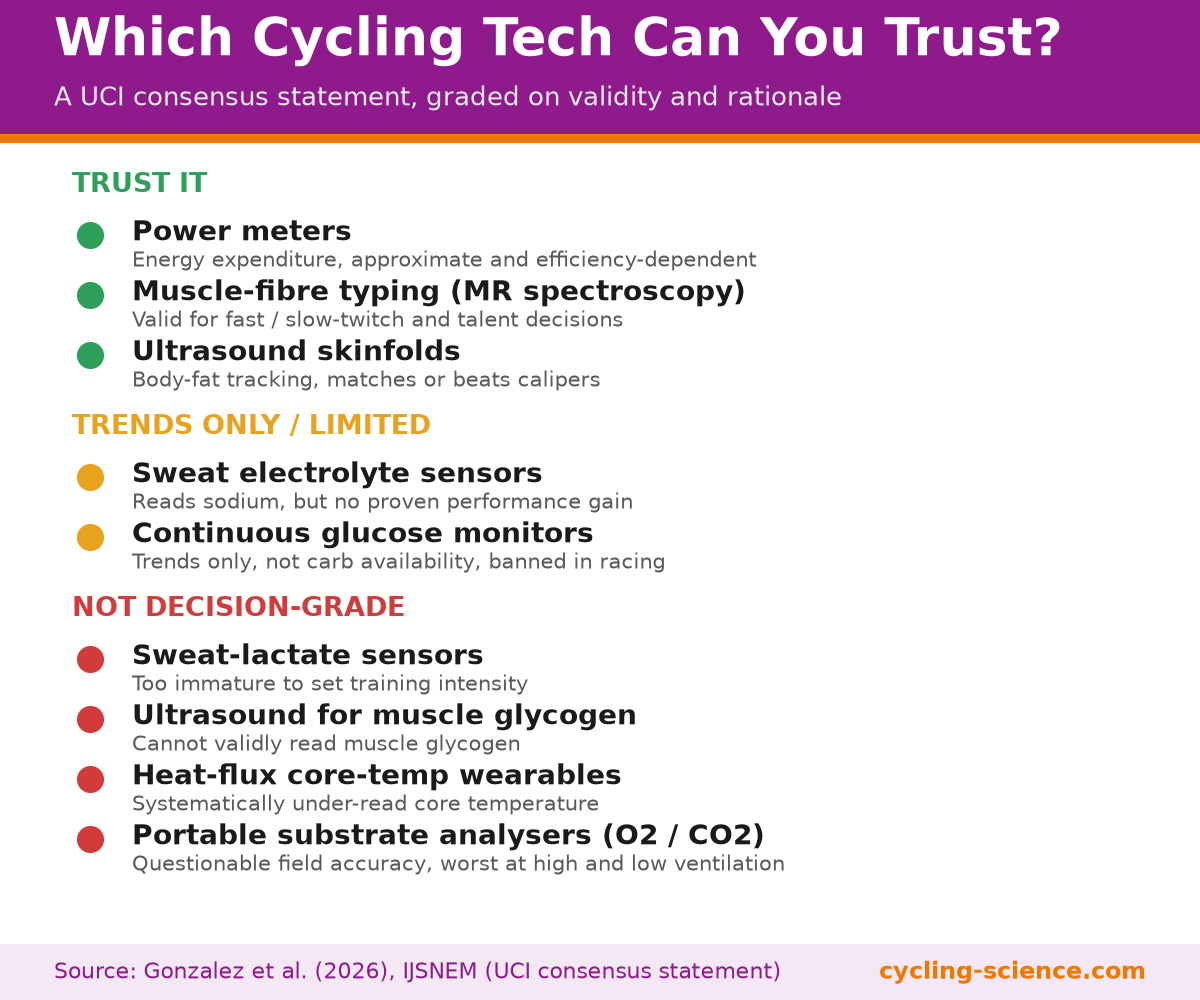
The clearest green light is the power meter. A calibrated unit measures power to within a few percent, and that makes it the one field tool reliable enough to plan fuelling around. But treat the energy-expenditure figure as a ballpark, not gospel. Converting watts to calories is not a straight line, and gross efficiency varies between riders and drifts downward across a long ride. Use it to size your carbohydrate intake to the work required, not to chase precise numbers.
Two other tools earn trust. Non-invasive muscle-fibre typing by magnetic-resonance spectroscopy genuinely reads whether a rider skews fast- or slow-twitch, which is useful for discipline and talent decisions if you can access a scanner. And B-mode ultrasound of subcutaneous fat matches or beats skinfold calipers for tracking physique over time.
The disappointments are where money often goes. Continuous glucose monitors show only general trends: interstitial glucose lags real blood changes by ten to fifteen minutes, is not a marker of your carbohydrate availability, and is banned in competition anyway. Wearable sweat sensors can read local sodium, but no study shows that personalised electrolyte dosing actually makes you faster, and sweat-lactate sensors remain too immature to set intensity. Most striking, the review concludes that ultrasound cannot validly read muscle glycogen, and that heat-flux core-temperature wearables systematically under-read core temperature, so using either to guide fuelling, pacing or cooling is not yet supported.
The same caution applies to portable substrate-metabolism analysers, the handheld oxygen and carbon-dioxide devices that claim to read your carbohydrate and fat burning in real time. A number of these have reached the market, but measuring gas exchange accurately outside a laboratory is genuinely hard, and the review found their field accuracy questionable, with errors growing at high and low breathing rates. Treat the numbers they produce as indicative at best, not as a basis for changing your fuelling.
The Bottom Line
Before you act on any wearable’s number, apply two tests. Could this metric actually change a decision, and is the device’s error smaller than the change you care about? Right now that means trusting power-based energy expenditure, muscle-fibre MRS and ultrasound skinfolds, while treating glucose monitors, sweat-lactate and core-temp wearables as interesting but not decision-grade.
Which of these have you spent money on, and did the data ever actually change what you did?
Reference
Gonzalez, J.T., Helleputte, S., van Erp, T., Green, D., Podlogar, T., Derave, W., Jeukendrup, A., & Burke, L.M. (2026). Nutritionally Relevant Technological Advancements in Professional Cycling. International Journal of Sport Nutrition and Exercise Metabolism. https://doi.org/10.1123/ijsnem.2025-0048
Evidence quality: Meta-analysis/Review (UCI consensus statement). Synthesised via the Cycling Science Living Knowledge Base.
This post is grounded in peer-reviewed research. Nutritionally Relevant Technological Advancements in Professional Cycling (Gonzalez et al., 2026) was synthesised into the Cycling Science Knowledge Base on 18 July 2026.
Apply this to your training
Want to train with the science behind you? Prof. Richard Davison offers evidence-based coaching built on exactly this kind of research.
View coaching packages →