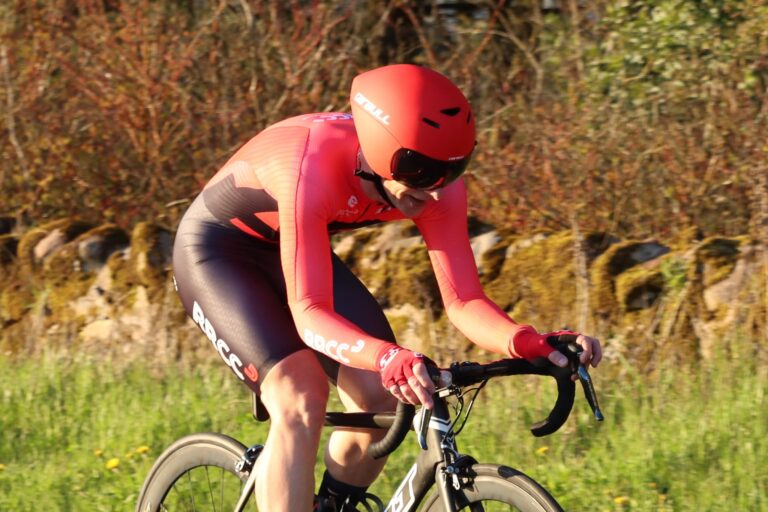
Last night I marshalled a local time trial, standing at the dead turn where riders double back on themselves. What I watched was a quiet tragedy repeated over and over: riders braking far too early, grinding almost to a halt, a few unclipping and planting a foot on the tarmac before wobbling back up to speed. Every one of them handed back time they had worked hard to earn out on the course.
Count the cost
Put a number on it. Say a clumsy turnaround costs you five seconds against a rider who flows through it. Five seconds doesn’t sound like much until you ask what it takes to find five seconds anywhere else. To trim that from your engine you might need weeks of structured intervals to nudge your sustainable power up by a handful of watts. The turn gives the same five seconds back for the price of an afternoon in a quiet car park practising. There is no other place in our sport where the return on effort is so lopsided.
Why the turn is so expensive
The physics is unforgiving. Speed scrubbed off with the brakes is kinetic energy thrown away as heat, and every bit of it has to be bought back with your legs on the way out. Acceleration costs far more than holding a steady pace, so the rider who brakes hard and sprints away pays twice. Modelling of time trial courses confirms that the way you carry speed through technical sections has a real effect on finishing time, and that the smoother answer is usually to lose a little speed in the corner rather than to keep stamping on the pedals to recover it (Zignoli, 2021). Good cornering is not bravado. It is choosing the line and the braking point that let you keep the most speed for the least energy.
The thing a downloaded plan can’t fix
This is exactly where a properly qualified coach earns their keep. You can download a training plan in seconds now, or ask an AI to build one, and for raw fitness that may even be a reasonable start. But no plan written to a spreadsheet can watch you corner. A good coach can. They will stand at the turn, or film you on a phone, and actually see what you are doing — where your eyes go, when you grab the brakes, how you set your entry line, what your body does mid-corner, and how cleanly you get back on the power at the exit.
From that the coach does something a plan cannot: they break the corner into its parts. Cornering is not one skill but a chain of small ones — sighting the exit, choosing the braking point, setting entry speed, leaning the bike, holding a relaxed upper body, then driving out. A coach can spot which link in that chain is costing you the five seconds, isolate it, and build a practice element to fix just that piece. Looking too soon? A drill for vision. Braking mid-turn? A progression that moves your braking earlier and lighter until you trust the entry speed. Then they layer the pieces back together until the whole turn flows. That loop of observe, diagnose, isolate, rehearse, and reassemble is coaching, and it is precisely the part of getting faster that a downloaded file will never do for you.
Grasp the nettle
There’s a mental trap here too. Tell yourself “I’m just not good at cornering” and you’ve written the result before you’ve turned the bars. The belief tightens your shoulders, drags your eyes down, and makes the very stiffness that confirms it. The riders who improve are the ones who decide it is a skill like any other, seek help, and practise it deliberately until the turn stops being something they survive and becomes something they use.
The bottom line
The dead turn is free speed sitting in plain sight. It costs you nothing in fitness and only a little in humility and practice. Brake later than feels comfortable, look through the turn to where you want to go, stay relaxed, and carry your speed — and if you want it fixed properly, get a coach to watch you and break the skill down. You may never find an easier five seconds.
Where are you losing time in your turns, and what’s stopping you from practising them this week?
References
Zignoli, A. (2021). Influence of corners and road conditions on cycling individual time trial performance and ‘optimal’ pacing strategy: A simulation study. Proceedings of the Institution of Mechanical Engineers, Part P: Journal of Sports Engineering and Technology. https://doi.org/10.1177/1754337120974872
Supporting work: optimal-control modelling of pacing and cornering strategy in time trials (https://doi.org/10.1007/s12283-020-00326-x), and analysis of bike handling through TT corners adapted from motorcycle racing, European Journal of Sport Science (https://doi.org/10.1080/17461391.2021.1966517).
Apply this to your training
Want to train with the science behind you? Prof. Richard Davison offers evidence-based coaching built on exactly this kind of research.
View coaching packages →